Sustainable pet food
Why plant-based?
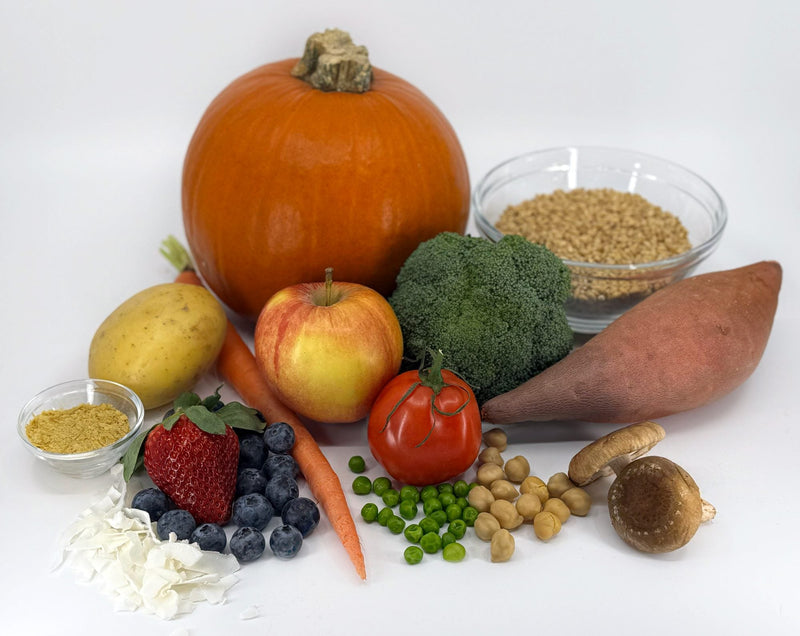
Eating a diet of mostly plants is one of the most impactful ways each of us can reduce our environmental footprint: slowing global warming, saving species from habitat loss, and cutting chemical and water use. It also avoids the most common food allergens for dogs.
If you’re reducing or eliminating animal ingredients from your own diet, why shouldn’t your whole household be able to contribute?

Impact calculator
What would your companion save by going plant-based?
Add each dog or cat, their weight and what they eat now. We’ll estimate what switching to Virtuous Vittles® saves in greenhouse gases, water, land, meat and animal lives.
Your companions
Switching to Virtuous Vittles® saves, each year
- lbs of greenhouse gasesmiles of air travel
- gallons of fresh watershowers
- sq ft of farmlandbasketball courts
- lbs of meat & fishwatermelons
Hover or tap a circle to see what that looks like.
And spares the lives of
 0chickens, turkeys & ducks
 0pigs
 0cows
 0fish (estimate)


How we calculate this
We estimate how many calories each companion needs from their weight (dogs: 95 kcal × body weight in kg to the 0.75 power each day, the European pet food industry guideline for an average adult dog; cats: 100 kcal × body weight in kg to the 0.67 power, the National Research Council guideline for adult cats), then apply published environmental footprints per 1,000 calories of food. We use the same footprints for cat food as dog food.
An average lifetime is 12.5 years for dogs (McMillan et al., 2024, Scientific Reports) and 11.7 years for cats (Teng et al., 2024, Journal of Feline Medicine and Surgery).
Greenhouse gases are measured as CO₂ equivalent (CO₂e): methane and nitrous oxide, which animal farming releases in large amounts, are converted to the amount of CO₂ that would cause the same warming and added together. We use the medians for commercial canned (33.6 kg CO₂e) and dry (4.3 kg CO₂e) pet foods from Pedrinelli et al., 2022, Scientific Reports. For plant-based food we apply the 75% reduction Knight, 2023 (PLOS ONE) found for vegan versus typical dog food.
Land and water: built from Poore & Nemecek, 2018 (Science) ingredient data for a typical pet food mix of poultry, beef, pork and fish, with the 86% (land) and 33% (water) reductions Knight, 2023 found for vegan dog food.
Meat and fish: canned food gets about 90% of its calories from animal ingredients (Pedrinelli et al., 2022) and dry food about half. We convert those calories to pounds of raw meat and fish at about 1.5 calories per gram.
Land animals: Knight, 2023 estimates that U.S. dogs eat about 1.7 billion farmed land animals a year. We scale that to your companion’s calories and split it by species using U.S. slaughter numbers. Birds (chickens, turkeys and ducks) are by far the most; sheep, goats and rabbits are each well under 1 in 1,000 and aren’t shown. Any share of an animal counts as a whole animal, since eating any part of an animal means one died.
Fish (estimate): no study has counted fish per dog or cat, so this one is our rough estimate. We assume fish makes up about 10% of the animal ingredients and an average fish of about 150 grams, a mix of small forage fish like anchovies and sardines and larger fish.
Equivalents: 0.164 kg of CO₂e per mile of long-haul air travel (U.S. EPA GHG Emission Factors Hub), 17.2 gallons per shower (EPA WaterSense), 4,700 sq ft per basketball court, 20 pounds per average watermelon (National Watermelon Promotion Board). These are estimates for a typical companion, not lab measurements of your companion’s food.
Sources: Pedrinelli et al., 2022 · Knight, 2023 · Poore & Nemecek, 2018 (Our World in Data) · Okin, 2017


Environmental impact of pet food
Animal agriculture wreaks environmental and ethical havoc
It accounts for:
-
14.5%
of global greenhouse gas emissions come from livestock
-
41%
of global deforestation, and 80% of Amazon deforestation
-
77%
of the world’s farmland, for only 18% of our calories
-
11B
farm animals killed in the U.S. every year
-
99%
of U.S. farmed animals live on factory farms
-
275 lbs
of meat a year for a 50 lb dog, about the same as an average American adult
Recyclable pet food cartons
Sealed fresh, shipped light, easy to recycle
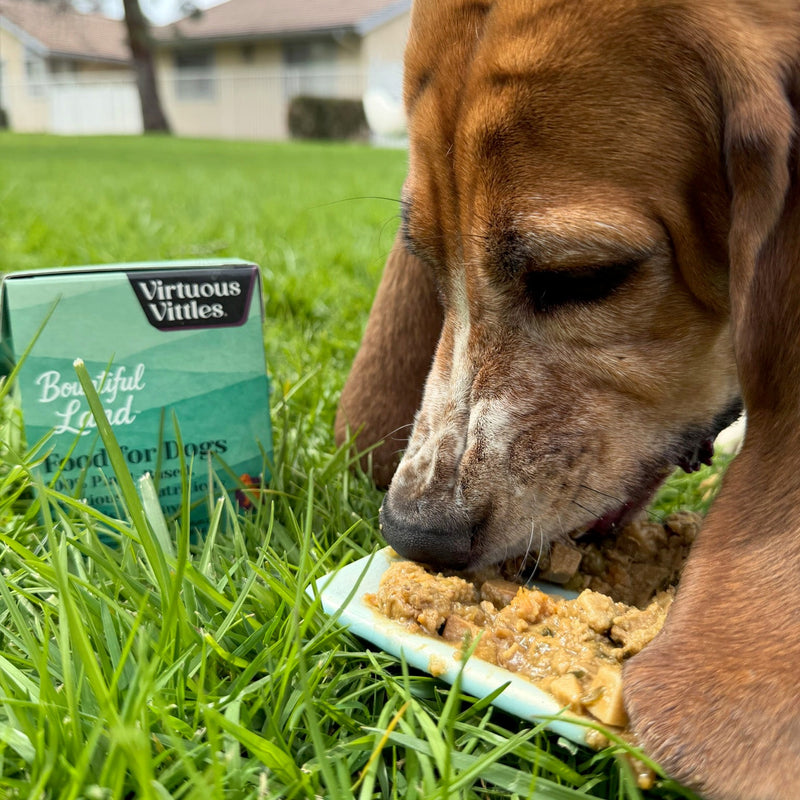
We use retort cooking: each meal is sealed in its carton, then gently cooked and sterilized with steam right in the package. That locks in nutrients and keeps meals shelf-stable for up to two years with no artificial preservatives and no refrigeration needed until opened, so there’s no cold-chain shipping either.
Our meals come in Tetra Pak® cartons, which are about 70% paperboard, BPA-free and recyclable through programs that reach about 70% of U.S. households (check yours). Rectangular cartons fit 10–50% more product per load than round cans, and they’re far lighter, which cuts transportation emissions.
It’s all part of being Good for Every Living Being on the Planet®.

Vegan pet food blog
Read more on Feeding the Future