If you read your own food labels, hopefully you read your dog's too. And if you've spent any time looking at premium pet food packaging, you've noticed that "human-grade" and "human-quality ingredients" appear on roughly half the brands on the shelf. They sound similar. They aren't.
This guide walks through what "human-grade" actually means as a legal and manufacturing standard, why the distinction matters for ingredient safety and traceability, and how to evaluate a brand against the true standard and see through marketing fluff.
What does "human-grade" actually mean?
In US pet food regulation, "human-grade" has a specific definition. The Association of American Feed Control Officials (AAFCO) formalized a Human Grade Pet Food Standard in 2023. To legally use the claim:
- Every ingredient must be human-edible — produced under human-food regulations and fit for human consumption.
- The product must be manufactured in a facility registered with the FDA as both a human food and an animal food facility, fully compliant with 21 CFR Part 117 — the FDA's Current Good Manufacturing Practice rule for human food.
Both conditions have to be true at the same time. A pet food made with human-grade ingredients but produced in a feed-grade facility doesn't qualify. Neither does one made in a human-food facility with feed-grade ingredients.
The phrases "human-quality ingredients" or "made with human-grade ingredients" — without the facility qualification — are marketing claims, not the AAFCO Human Grade standard. If a brand can't or won't confirm the facility is FDA-registered for human food and 21 CFR Part 117 compliant, the ingredient claim alone doesn't clear that bar.
Feed-grade vs. human-grade: the manufacturing difference

Most premium pet foods — including well-known names — are manufactured in feed-grade facilities. These are regulated by the FDA under the Food Safety Modernization Act (FSMA), specifically the animal food preventive controls rule (21 CFR Part 507). That's a meaningful safety standard — but it's nowhere near the same standard facilities for producing human food are held to.
The differences that matter:
- Permitted ingredients. Feed-grade facilities can source ingredients not approved for human consumption, including rendered byproducts and meat-meal. Industry reporting has long documented that "4D" animal material (dead, dying, diseased, or down) has entered the rendered pet food supply under FDA discretionary enforcement, though FDA's formal position is that material from animals that died other than by slaughter is not lawfully usable.
- Inspection regime. Human-food facilities operate under 21 CFR Part 117 — the hazard analysis and preventive-controls framework that watches the human food supply. Feed-grade facilities operate under the parallel 21 CFR Part 507. The two rules are structurally similar but Part 507 is meaningfully looser: it does not require human-edible ingredient sourcing, lacks allergen preventive controls, and has less detailed sanitation requirements.
- Traceability. AAFCO's Human Grade standard requires a documented chain of custody for every ingredient and the resulting product — country of origin, supplier records, batch testing — by default.

A concrete example: the word "chicken" on a label means different things in feed-grade and human-grade products. On a human-grade label, "chicken" must be USDA-inspected muscle meat meeting specific composition standards. In feed-grade pet food, AAFCO defines "chicken" as flesh and skin "with or without accompanying bone... suitable for use in animal food" — explicitly not requiring USDA inspection, and potentially ranging from nearly all meat to nearly all skin and bone.
For a guardian who applies the same scrutiny to their dog's food that they apply to their own, the facility distinction is the one that matters. It's the difference between "we like the idea of human-quality ingredients" and "the same regulatory regime that watches your groceries watches this food."
Why ingredient quality matters
The case for higher-quality ingredients in dog food parallels the case for them in human food. Whole-food, minimally-processed diets correlate with better health outcomes; ultra-processed diets correlate with worse ones. The pattern from human nutritional research is consistent: recognizable whole foods support the gut microbiome, reduce systemic inflammation, and deliver nutrients in more bioavailable forms than their processed analogs.
The most rigorous comparative work in dogs to date comes from the DogRisk group at the University of Helsinki. Across multiple studies tracking dogs fed ultra-processed dry kibble versus raw diets, puppies fed ultra-processed kibble showed significantly higher rates of adult atopic dermatitis (Hemida et al. 2020), allergy and atopy skin signs (Hemida et al. 2021), and ear inflammation (Hemida et al. 2023) than puppies fed minimally-processed raw diets. The direct comparison between cooked whole-food and extruded kibble hasn't been published — but the broader pattern is consistent: less processing, better outcomes.
Conventional pet food has been slow to catch up. The dominant manufacturing format — high-heat extrusion of meal and byproduct, with synthetic vitamins and minerals added back in to replace nutrients destroyed by processing — is closer to ultra-processed human food than to whole-food cooking. Human-grade facilities, by contrast, typically use lower-temperature processing methods that preserve more of the nutrient value of recognizable ingredients.
Worth asking any pet food brand: does their process preserve the nutrients they advertise, or destroy them? Whole-food ingredients only deliver whole-food nutrition if the process preserves them.
What to look for when choosing a human-grade dog food
Five filters that separate genuine human-grade products from marketing imitations:
- An AAFCO Human Grade Pet Food Standard statement — not "human-quality ingredients" or "made with human-grade ingredients." Look for explicit confirmation that the food is manufactured in an FDA-registered human-food facility under 21 CFR Part 117.
- AAFCO complete-and-balanced statement. Human-grade doesn't override nutritional adequacy. Any dog food serving as the primary diet has to meet AAFCO's nutrient profiles.
- Country-of-origin transparency for every major ingredient. Brands that can name where each ingredient comes from generally have the supply chain to back it up.
- Recognizable whole-food ingredients in the first five positions of the ingredient list. If the top five are "chicken meal, brewers rice, corn gluten, animal fat, natural flavor," that's not what whole-food feeding looks like.
- Formulated by a board-certified veterinary nutritionist. Especially important for any non-conventional diet — the credentials to look for are Dipl. ACVN (American College of Veterinary Nutrition) or Dipl. ECVCN (European College of Veterinary and Comparative Nutrition).
Virtuous Vittles: human-grade, plant-based, and vet-formulated

Virtuous Vittles meets the full human-grade standard:
- Manufactured in an FDA-registered human-food facility, fully compliant with 21 CFR Part 117 — the same Good Manufacturing Practice rule that applies to the human food produced in the same plant. Meets AAFCO's Human Grade Pet Food Standard.
- Human-edible ingredients with full country-of-origin transparency
- AAFCO complete-and-balanced for adult maintenance
- Formulated by Dr. Sarah Dodd, BVSc, MSc, PhD, DECVCN — a board-certified veterinary nutritionist whose own published research is part of the literature this article cites
- Made in the USA with carefully selected, globally sourced ingredients
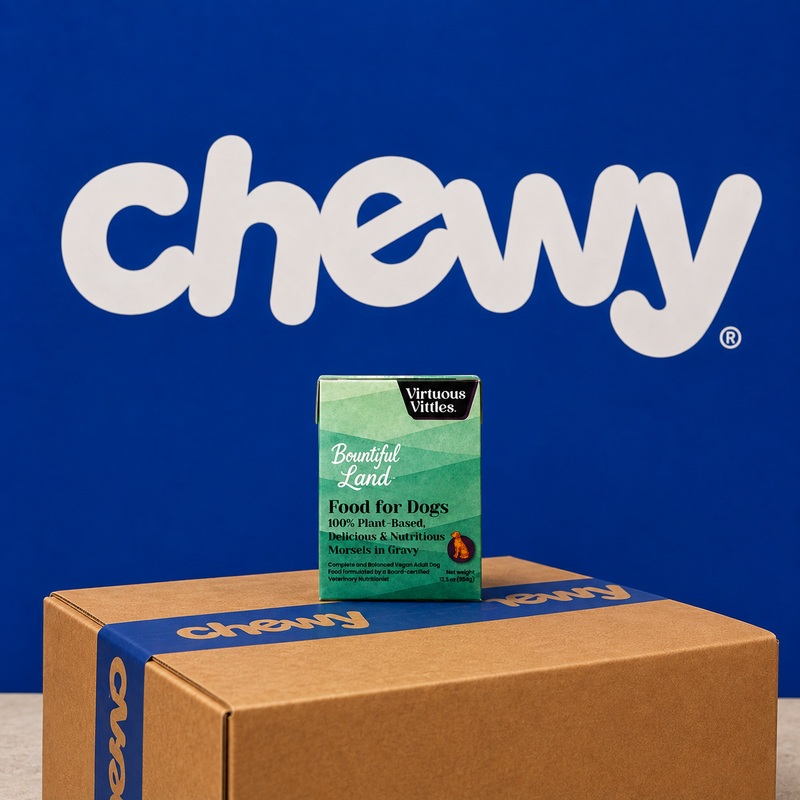
The format differentiator: shelf-stable morsels in savory gravy, the only shelf-stable wet human-grade option in the plant-based dog food category. Open and serve like canned food (try it with the Bountiful Land® Bark Sampler) — no refrigeration, no subscription, no logistical friction.
A note on the plant-based piece. For a guardian working from an ingredient-quality framework, plant-based is the logical endpoint of the same scrutiny. No animal proteins means no 4D meat exposure, no rendering byproducts, no opaque supply chains, no antibiotic residues from industrial livestock. And for dogs with food sensitivities, it removes the animal proteins behind most food allergies (see our guide to the best dog food for allergies). It's the same case for whole-food integrity that humans make when they read their own labels.
And on longevity: in a 2022 study from the University of Guelph that surveyed North American dog guardians about the lifespans of their previously-owned dogs, dogs fed plant-based diets were reported to live an average of 1.5 years longer than dogs fed meat-based diets (14.1 vs. 12.6 years; Dodd, Khosa, Dewey & Verbrugghe 2022). The authors are explicit that this is owner-reported survey data and warrants prospective trials to confirm — but the association is striking and consistent with what the broader research base on plant-based dogs is starting to show. For a deeper read on what that research base looks like overall, see our guide to vegan dog food.
Sources
- Dodd SAS, Khosa D, Dewey C, Verbrugghe A. Owner perception of health of North American dogs fed meat- or plant-based diets. Research in Veterinary Science. 2022;149:36–49.
- Hemida M, Vuori KA, Salin S, Moore R, Anturaniemi J, Hielm-Björkman A. Identification of modifiable pre- and postnatal dietary and environmental exposures associated with owner-reported canine atopic dermatitis in Finland using a web-based questionnaire. PLOS ONE. 2020;15(5):e0225675.
- Hemida M, Salin S, Vuori KA, Moore R, Anturaniemi J, Rosendahl S, Barrouin-Melo SM, Hielm-Björkman A. Puppyhood diet as a factor in the development of owner-reported allergy/atopy skin signs in adult dogs in Finland. Journal of Veterinary Internal Medicine. 2021;35(5):2374–2383.
- Hemida M et al. Early life programming by diet can play a role in risk reduction of otitis in dogs. Frontiers in Veterinary Science. 2023.
- Association of American Feed Control Officials. AAFCO Standard for "Human Grade" Pet Food (2023).
- Association of American Feed Control Officials. Human Grade Pet & Specialty Pet Food Claim — FAQ (September 2024).
- U.S. Code of Federal Regulations. 21 CFR Part 117 — Current Good Manufacturing Practice, Hazard Analysis, and Risk-Based Preventive Controls for Human Food.
- U.S. Code of Federal Regulations. 21 CFR Part 507 — Current Good Manufacturing Practice, Hazard Analysis, and Risk-Based Preventive Controls for Food for Animals.
- U.S. Food and Drug Administration. FSMA Final Rule for Preventive Controls for Animal Food.