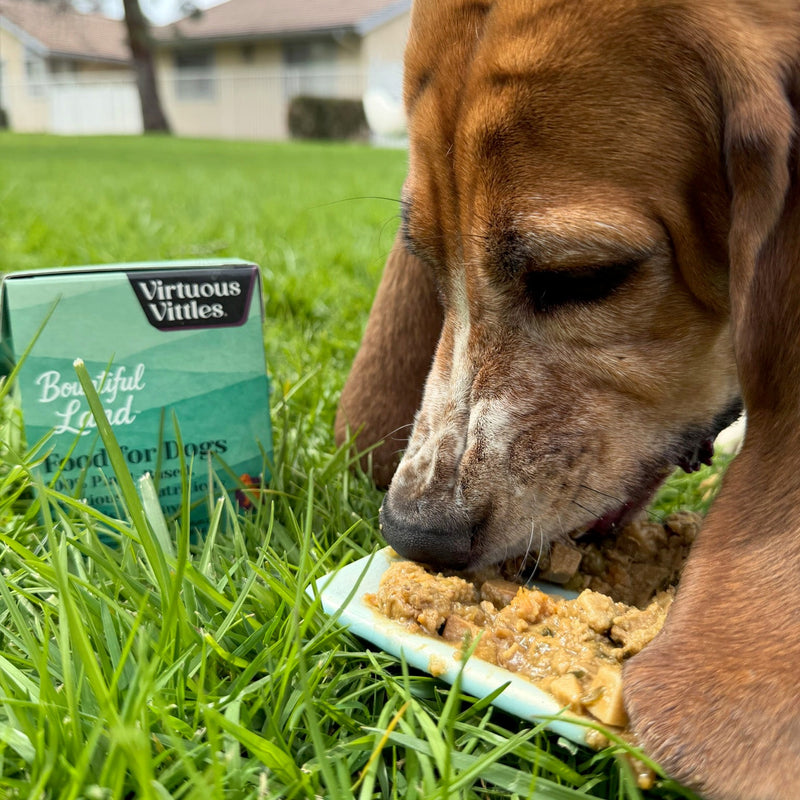
If you're comparing the best vegan dog food brands, you've probably already decided your dog can eat plant-based. The research supports you: dogs on nutritionally complete vegan diets show health outcomes as good as, and in several studies better than, dogs on meat-based food. The harder question is which brand fits your dog.
We should say up front that we make one of them. Virtuous Vittles is a plant-based dog food company, so we have a stake in this list. We wrote it anyway, because most roundups skip what matters most: who formulated the food, how it's tested, what format it comes in and how it fits your daily life. Below you'll find nine brands, our own included, reviewed on the same criteria.
Key takeaways
- Every food worth considering carries an AAFCO complete-and-balanced statement. Treat a food without one as a topper, not a diet, and ask whether the finished food is lab-tested rather than only formulated on paper
- Brands differ most in format and storage (kibble, canned, frozen or shelf-stable wet) and in who formulates the recipe. Frozen food also brings freezer space, subscription delivery and cold-chain shipping into the decision
- A board-certified veterinary nutritionist (DACVIM-Nutrition, DACVN or DECVCN) is the strongest formulation credential, and only two brands in this guide name one
- Look past “human-grade ingredients.” A human-grade food is made to human-food standards from start to finish, and it's rare in this category
- Three of the lines here, from Halo, Evanger's and Natural Balance, are add-ons from brands built mostly on meat-based food, not recipes developed from a plant-based perspective
- For dogs with food allergies, any complete vegan formula removes the animal proteins behind most confirmed food allergies in one switch
In this guide
- Is vegan dog food safe and nutritionally complete?
- What should you look for in a vegan dog food?
- Which vegan dog food brands are worth considering in 2026?
- Our pick: Virtuous Vittles
- Is vegan dog food good for dogs with allergies?
- How do you switch your dog to vegan food?
- Conclusion: matching the food to your dog
Is vegan dog food safe and nutritionally complete?
Yes, when it's formulated to meet your dog's full nutrient needs. Dogs are omnivores. They carry extra copies of the AMY2B gene for digesting starch compared with wolves, and they make taurine and other key nutrients from precursors in their diet. Our guide to whether dogs are omnivores covers the evolutionary evidence.
The health research is consistent. A 2022 survey of 2,536 dogs found those on vegan diets were reported to be as healthy as, or healthier than, dogs on conventional diets (Knight et al., 2022). A 2024 reanalysis that controlled for age, sex, breed size and exercise found lower odds of several specific disorders in plant-fed dogs (Knight, Bauer & Brown, 2024). And in a year-long clinical trial, 15 dogs eating a commercial plant-based diet maintained clinical, nutritional and blood health at every quarterly check (Linde et al., 2024).
Every one of these studies carries the same qualifier: the diet has to be complete and balanced. That's why the label matters more than the marketing. For the full research picture, see our complete guide to vegan dog food.
What should you look for in a vegan dog food?
Six checks separate a complete plant-based diet from a good-sounding label:
- The right life stage. Look for “formulated to meet the nutritional levels established by the AAFCO Dog Food Nutrient Profiles,” followed by adult maintenance, growth or all life stages. “All life stages” means the food meets puppy (growth) requirements, so it carries more of some nutrients, such as calcium and phosphorus, than a grown dog needs. For an adult dog, a food formulated specifically for adult maintenance is the more precise fit
- A named board-certified veterinary nutritionist. “Vet-developed,” “veterinarian-endorsed” and “board-certified animal nutritionist” are different things. A board-certified veterinary nutritionist is a veterinarian with a nutrition residency and specialty exam, shown as DACVIM (Nutrition), DACVN or DECVCN. If a brand won't name its formulator, ask
- Lab-tested finished food. A recipe can meet AAFCO on paper and still fall short after cooking. Look for third-party testing of the finished food against the full AAFCO nutrient panel: every vitamin, mineral, amino acid and fatty acid, not only protein and amino acids. Brands that test the full panel should publish the results
- Proteins you recognize, such as peas, lentils, chickpeas, soy or wheat gluten
- A format that fits your kitchen. Frozen food needs freezer room and usually a subscription, and it travels in a refrigerated supply chain. Shelf-stable food sits in the pantry
- Human-grade, start to finish. “Human-grade ingredients” on a bag only describes what went in. A human-grade food is made entirely to human-food standards, from the ingredients to the facility it's cooked and packed in, under the same FDA rules that cover food for people. Most dog food, plant-based or not, is made in pet food plants instead

Which vegan dog food brands are worth considering in 2026?
We compared nine brands that sell vegan or vegetarian dog food, our own included, on format, storage, testing and who formulates the food. Details come from each brand's own website, press releases and product listings as of October 2026. Where a brand doesn't name its formulator or state a credential, we say so. Recipes change, so check the current label before you buy.

| Brand | Format | Storage | Formulator, as the brand states it | Human-grade meal |
|---|---|---|---|---|
| Wild Earth | Kibble | Pantry | Veterinarian Dr. Ernie Ward with veterinarians, animal nutritionists and food scientists (no board-certified veterinary nutritionist named) | Not stated |
| Halo Garden of Vegan | Kibble and canned pâté | Pantry | Animal nutritionists and veterinarians (no board-certified veterinary nutritionist named) | Not stated |
| Evanger's Vegetarian Dinner | Canned; vegetarian, contains egg | Pantry | Not stated | Not stated for this recipe |
| Natural Balance Vegetarian | Kibble and canned | Pantry | Veterinary and nutrition experts (not named) | Not stated |
| V-Dog | Kibble and canned pâté | Pantry | Veterinary nutritionists and PhD pet food experts; board certification not stated (not named) | Not stated |
| Petaluma | Oven-baked kibble; dehydrated mixer | Pantry | Board-certified veterinary nutritionist Dr. Sarah Dodd (named) | Mixer only; kibble is made in a pet food bakery |
| PawCo | Cooked, frozen meals; shelf-stable bites | Mostly freezer; subscription plans | Board-certified animal nutritionists, a non-veterinary credential (not named) | Human-grade ingredients |
| Bramble | Cooked, frozen meals | Freezer; subscription delivery | Board-certified veterinary nutritionists (not named) | Yes |
| Virtuous Vittles | Morsels in savory gravy | Pantry; no subscription required | Board-certified veterinary nutritionist Dr. Sarah Dodd (named) | Yes |

Wild Earth
Kibble made with koji and yeast proteins
Wild Earth became widely known after a 2018 Shark Tank deal. Its kibble uses koji and yeast proteins alongside chickpeas and peas, and meets AAFCO adult maintenance profiles. The brand says its recipes were developed by a team of veterinarians, animal nutritionists and food scientists, including its chief veterinary officer, veterinarian Dr. Ernie Ward.
In 2025 the company filed for Chapter 11 and was then bought out of bankruptcy, and it continues to sell food under new ownership.
Trade-offs: dry food only for dogs, and the ownership change is worth watching if you plan to subscribe long term
Best for: kibble feeders who want a high-protein option
Add-on line from a meat-based brand
Halo Garden of Vegan
Kibble and canned pâté
Halo is a mainstream brand whose range is built mostly on meat-based recipes, with a small vegan line in kibble and canned pâté sold widely in stores and online. The recipes use peas and chickpeas as main proteins and meet AAFCO adult maintenance profiles. Halo says the recipes were developed with animal nutritionists and veterinarians, and it has quoted its veterinary advisor, Dr. Donna Spector, on the vegan line. It doesn't name a board-certified veterinary nutritionist as the formulator.
Trade-offs: the vegan recipes are an add-on to a meat-based range rather than a food developed from a plant-based perspective, and the canned format is a pâté rather than chunks
Best for: guardians who want a vegan kibble or pâté they can grab on an ordinary store run
Add-on line from a meat-based brand
Evanger's Vegetarian Dinner
Canned vegetarian recipe for dogs and cats
Evanger's is a Chicago-area brand known mostly for canned meat and game dinners. Its Vegetarian Dinner is a canned recipe of sweet potatoes, potatoes, brown rice, vegetables and fruit, formulated for all life stages for both dogs and cats.
One detail matters for plant-based households: it's vegetarian, not vegan. Dried eggs are on the ingredient list. Evanger's doesn't name who formulates it.
Trade-offs: it contains egg, it's a side line from a meat-focused brand, and it's built to puppy-level requirements as an all-life-stages food
Best for: vegetarian households that want an inexpensive canned option
Add-on line from a meat-based brand
Natural Balance Vegetarian
Limited Ingredient Vegetarian Recipe, kibble and canned
Natural Balance is a long-running brand known for limited-ingredient diets, most of them meat-based. Its Limited Ingredient Vegetarian Recipe comes as kibble and a canned recipe, both made without animal or dairy products and built around brown rice, barley, oats and peas, with added taurine. Natural Balance says the recipes were developed with veterinary and nutrition experts but doesn't name them.
Trade-offs: the vegetarian recipes are positioned mainly for dogs with food sensitivities, as part of a meat-based range, rather than developed from a plant-based perspective
Best for: kibble feeders who want a widely available vegan option
V-Dog
Kind Kibble, Mini Bites and Happy Harvest canned food
V-Dog has made vegan dog food since 2005, which makes it one of the longest-running brands in the category. It did much of the early work of showing guardians that dogs can thrive on plant-based food. Its Kind Kibble uses peas, lentils, quinoa and brown rice, skips corn, soy and wheat, and adds taurine, L-carnitine and plant-based DHA.
It also makes a mini-bite kibble for small dogs and Happy Harvest, a canned pâté that meets AAFCO profiles for both adult dogs and puppies. V-Dog says it consults veterinary nutritionists and PhD pet food experts on formulation and works with a team of veterinarians experienced in plant-based diets for dogs.
Trade-offs: the soft food is a pâté in a single recipe, so dogs who prefer chunks or gravy may want something alongside it
Best for: budget-conscious guardians who value a long track record, including those raising a puppy on plant-based food
Petaluma
Oven-baked kibble and a dehydrated mixer
Petaluma makes oven-baked kibble rather than the extruded kind, baked in a solar-powered facility in Illinois with mostly organic ingredients, plus a senior recipe and a dehydrated, just-add-water mixer.
Since 2025, its advisor and formulator has been Dr. Sarah Dodd, the same board-certified veterinary nutritionist who formulates our food. We'd rather tell you that than leave it out. It also shows how few specialists work in plant-based nutrition.
Trade-offs: dry and dehydrated formats only, with no ready-to-serve wet food, and baked kibble usually costs more per pound than extruded kibble
Best for: kibble feeders who want organic ingredients and baked rather than extruded kibble
PawCo
Cooked, frozen meals, plus shelf-stable InstaBites
PawCo was founded in San Francisco by Dr. Mahsa Vazin, a food scientist who previously worked at Impossible Foods. Its core line is cooked and frozen plant-based meals sold through subscription plans, alongside a shelf-stable option called InstaBites and a range of treats and toppers.
PawCo says its food is formulated with “board-certified animal nutritionists” and veterinary oversight. Animal nutritionists are nutrition scientists, but that certification isn't the veterinary nutrition specialty, and PawCo doesn't name who holds it.
Trade-offs: the main meals need freezer space, a subscription schedule and a refrigerated shipping chain
Best for: guardians who like trying new products, such as toppers, bars and treats, alongside a frozen meal plan
Bramble
Cooked, frozen meals by subscription
Bramble is a New York-based brand that makes cooked and frozen plant-based meals built around pea protein, sold by subscription. It says its recipes are formulated by board-certified veterinary nutritionists, though it doesn't name them. It says it lab-tests its recipes for amino acid profile, protein digestibility and bioavailability, and it commissioned a digestibility study at the University of Illinois. It recently added lower-protein, lower-phosphorus recipes for dogs who need kidney support.
Trade-offs: frozen meals need freezer space and a delivery schedule. They also depend on a cold chain from start to finish: refrigerated warehouses, refrigerated trucks and insulated boxes with ice packs, repeated with every subscription delivery. That adds cost and emissions that shelf-stable food avoids (our guide to sustainable dog food walks through the numbers)
Best for: guardians with freezer room who want a frozen meal plan, especially for a dog on a kidney-support diet
Our pick: Virtuous Vittles
Virtuous Vittles
Bountiful Land, 100% plant-based morsels in savory gravy
We started Virtuous Vittles because our founder couldn't square feeding her dog, Xiggy, ingredients she'd stopped eating herself. Bountiful Land is what we built in response: the first 100% plant-based morsels in savory gravy for dogs, closer to a stew than a spread.
- Formulated by Dr. Sarah Dodd, BVSc, MSc, PhD, DECVCN, a board-certified veterinary nutritionist who has published research on plant-based diets for dogs and cats
- Human-grade, start to finish, made in an FDA-registered human-food facility under the same FDA rules as food for people (21 CFR Part 117)
- Complete and balanced for adult maintenance, and third-party lab-tested against the full AAFCO nutrient panel, so the nutrients are verified in the finished food rather than only calculated on paper. We publish the results, linked from the nutrition section of every Bountiful Land product page
- No beef, chicken, dairy, egg, lamb, pork or fish, the animal proteins behind most confirmed canine food allergies
- Shelf-stable for up to two years in cartons that are fully recyclable where recycling is available, with no freezer, cold-chain shipping or subscription required
- Taste-tested: 95 of 100 dogs gobbled it up in our taste testing
“He loved it! As an older dog having soft food versus hard kibble is so much better for his dining experience :)”
Katey, guardian of Rudy
Trade-offs: Bountiful Land is precision-balanced for adult maintenance rather than all life stages, so it isn't a complete diet for puppies. A puppy-specific recipe is in development. Wet food also costs more per calorie than kibble, and many guardians stretch it by mixing our morsels with kibble, which works well
Best for: dogs who prefer wet food, picky eaters, seniors who do better with soft food, dogs with animal-protein allergies and guardians without freezer space

Is vegan dog food good for dogs with allergies?
For many dogs, yes. In a review of dogs with confirmed food allergies, beef accounted for 34% of cases, dairy 17% and chicken 15%, and most confirmed allergens were animal proteins (Mueller, Olivry & Prélaud, 2016). A complete vegan diet removes all of them in one switch, instead of rotating through one novel meat after another.
Wheat was the most common plant trigger in the same review, at 13% of cases. Several vegan foods use wheat, including our own recipes, which contain wheat gluten. If your dog reacts to wheat, check every label, ours included. Our guides to the best dog food for allergies and vegetarian dog food for allergies walk through the elimination process.
How do you switch your dog to vegan food?
Gradually, over 10 to 14 days. Mixing a little more of the new meal into each serving gives your dog's digestion time to adjust.
- Days 1 to 3: 25% new meal, 75% current meal
- Days 4 to 7: half and half
- Days 8 to 11: 75% new meal, 25% current meal
- Days 12 to 14: 100% new meal

Every dog is different, so stay at a step for a few extra days if yours needs more time. Wet food is often easier for fussy eaters, and mixing it into the old food helps. Check in with your vet at your next wellness visit, and ask about a taurine level on routine bloodwork if you'd like extra reassurance.
Conclusion: matching the food to your dog
The best vegan dog food brand is the one that's complete and balanced, formulated by a board-certified veterinary nutritionist you can name, lab-tested as finished food and eaten happily by your dog. Kibble feeders have options in Petaluma, V-Dog, Natural Balance, Wild Earth and Halo. Frozen meal plans from Bramble and PawCo suit guardians with freezer room and a regular delivery schedule. If you want a ready-to-serve, human-grade wet meal from a named board-certified veterinary nutritionist, without the freezer, the subscription or the cold chain, Bountiful Land was made for you.
This World Vegan Day, dinner is one of the easiest places to start. Every meal you switch is a meal made without farmed animals.
Sources
- Knight A, Huang E, Rai N, Brown H. Vegan versus meat-based dog food: guardian-reported indicators of health. PLOS ONE. 2022
- Knight A, Bauer A, Brown HJ. Vegan versus meat-based dog food: guardian-reported health outcomes in 2,536 dogs. Heliyon. 2024
- Linde A, et al. Domestic dogs maintain clinical, nutritional, and hematological health outcomes when fed a commercial plant-based diet for a year. PLOS ONE. 2024
- Mueller RS, Olivry T, Prélaud P. Common food allergen sources in dogs and cats. BMC Veterinary Research. 2016
- Brand details from each company's website, press releases and product listings, checked October 2026. Wild Earth ownership: Green Queen and BusinessDen reporting, 2025